Saturday, May 25, 2013

Road to Oz


Road to Oz
 By L. Frank Baum
Adapted by Eric Shanower and Skottie Young

4 1/2 out of 5 Covers

The fifth volume in Marvel Comics adaptation of the Oz series is another success.  This adventure begins with Dorothy and Toto helping the Shaggy Man find his way to Butterfield only to find themselves in Oz somehow along the way.  The story takes the form, as most Oz stories do, of a travelogue, recounting their journey across the land and the people they meet until they reach the Emerald City, just in time for Ozma’s birthday party.  Joining Dorothy on the journey are Button Bright, a little boy who doesn’t seem to know anything, and Poylchrome, the daughter of the rainbow (a character with which the colorist really gets to shine).

This is not Baum’s strongest work.  The cities they travel through (a city of foxes and a city of donkeys) aren’t as interesting or inventive as his past works.  He tries to make some social point with the comparison between the two, but it isn’t very clear.  It also doesn’t help that the Shaggy Man has a love magnet, which automatically makes everyone want to be helpful, as it undercuts any tension.

However, the encounter with the Scoodlers, villainous creatures who have two faces and can pull of their heads to throw as weapons and are unaffected by the love magnet, are among the most nightmarish of Baum’s creations.

Despite the simplicity of the story, Shanower and Young pour their hearts into the work.  Shanower is handicapped not only by the story but also by the fact that Marvel cut the number of issues from the usual 8 to 6.  There a definitely moments were the reader is told things rather than shown to speed up the journey.  Skottie Young is absolutely the best artist for these adaptations, as evidenced by the four previous volumes as well as this one.  His style is full of whimsy and can turn even Toto into a full blown character.

Even with the handicaps (which are not their fault), Shanower and Young do an impressive job of turning even a lesser work into a wonderful and enjoyable journey.

Friday, May 24, 2013

Adventure Time Volumes 1 and 2


Adventure Time Vol. 1
4 out of 5 Covers

Adventure Time Vol. 2
4 out of 5 Covers

Written by Ryan North
Illustrated by Shelli Paroline and Brandon Lamb

For those who don’t know, Adventure Time is an awesome cartoon that follows the adventures of Finn the Human and Jake the shape-shifting dog in the land of Ooo.  It often follows a absurdist fantasy format where the duo help rescue princesses from villains such as the Ice King, but Ooo is a world where literally anything can happen.  This has made for many exciting episodes with a wide range of humor.

The collection of the Adventure Time  comic starts things off with an explanation of how the footage for the opening credits were shot and what exactly everyone is doing in it.  This is a perfect introduction as it establishes the comic book’s connection to the tv show while establishing its own visual vocabulary.

The first volume sees Finn and Jake working to stop the archvillain the Lich from destroying Ooo by sucking it all into a magic bag.  Everybody has to do their part to help out, though the other characters don’t get much time to shine; this is definitely a Finn and Jake story.

The second volume begins with a one off tale of Finn and Jake seeing who can walk in the straight line the longest, leading them to meet Adventure Tim.  It’s a pretty surreal story, and one I really hope the adapt into the cartoon.

The rest of the volume involves time travel shenanigans resulting in a battle with killer robots from the future.  The initial seed of the story appears to be resolving an error from the pilot episode where a sleeping bag disappeared from the background.  But that is exactly what the show would do: tell an epic yarn to resolve one small error, with clearly established rules about time travel.

The creators of the comic clearly love the cartoon show.  Every word and image attests to their care and attention.  The art is clear and the colors are vibrant.  But the storytelling is also somewhat manic.  Finn and Jake in particular seem to be hyperactive, with none of the quieter, reflective moments that provide the tv show with its emotional power.  This is always the challenge of adapting an existing property: without the license to progress the characters, how does one provide empathy?

Adventure Time adapts extremely well to the comic book format.  But without those reflective pauses to contrast the adventure, the result feels like nonstop action with less meaning than should be there.

Thursday, May 23, 2013

How to Train Your Dragon Books 5 and 6


By Cressida Crowell

Book 5: How to Twist a Dragon’s Tale
4 out of 5 Covers

Book 6: A Hero’s Guide to Deadly Dragons
4 ½ out of 5 Covers

Hiccup Horrendous Haddock III’s troubles continue in Book 5 when a volcano threatens to unleash the Exterminator Dragons on the Viking.  These Exterminator Dragons are impossible to fight.  Fortunately, Hiccup gain a bodyguard in the form of the great Viking hero, Humungously Hotshot.  But Hotshot has a secret from the past that could spell Hiccup’s doom.

Obviously Hiccup wasn’t doomed, because there is a Book 6.  Hiccup, along with Fishlegs, Toothless and Camicazi, must sneak into the Meathead Public Library (on Hiccup’s birthday no less) to steal a copy of How to Train Your Dragon or Toothless will be banished for destroying the Hairy Hooligan tribe’s copy.  Can they get passed the Hairy Scary Librarian?  And what does it mean that there is book called A Hero’s Guide to Deadly Dragons by Hiccup Horrendous Haddock II?

Cressida Crowell increases the dramatic tension in these volumes by diversifying the threats and delving into the backstory of the world she has built.  While there have been attacks of differing sizes and powers, the Exterminator Dragons come across as a real threat that could destroy the Vikings, which makes Hiccup’s actions more heroic.  And the idea that one of Hiccup’s ancestors was, like him, fascinated by dragons is intriguing and drives the reader to continue on with the series.  Having established the Viking world in the first few books, the opportunity to develop the mythology and history of that world adds power to the plot.

And I’ll admit that I have a soft spot for Book 6 as it takes place in a library and addresses the power of books and reading.    

Wednesday, May 22, 2013

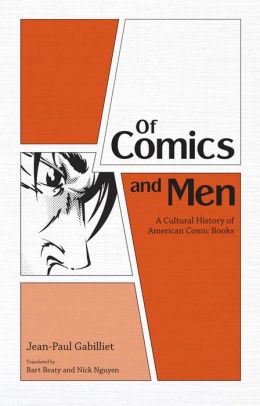
Of Comics and Men


Of Comics and Men: A Cultural History of American Comic Books
 By Jean-Paul Gabilliet
 Translated by Bart Beaty and Nick Nyguyen

3 ½ out of 5 Covers

I had a hard time deciding what score I should give this book.  As a history of the comic book industry, it is thorough, but it is a lot of the same material that I have encountered in other histories.  It sets itself apart by focusing on the economics of the producers and consumers, especially giving some in-depth attention to the fan community.  However, the business practices of the industry don’t greatly interest me.  That it not to say it isn’t important information that can give insight and depth that can be beneficial to an understanding of comic book history; it’s just that I will admit to speed reading through some of those sections.

The fact that this book was originally written in French might have provided an outsider perspective from a culture that respects comic books; I didn’t recognize any of that.  There were also a few printing errors that an editor should have caught.  As my brother Joseph will attest, these things do slip thorough.  That doesn’t change the fact that they are now there for everyone to see.

And the truth is that the prose is a little dry.  The comic book industry is full of larger than life personalities and its history is filled with ups and downs.  Gabilliet is pretty straightforward in his telling. 

So I vacillated between giving it an average and an excellent ranking. I worried that I was scoring it low in relation to other texts that I have read, but when I thought about ranking it higher, all the little problems seemed to pile up in my mind.  So I split the difference.

The truth is that such judgments are not made in a vacuum.  I will always relate what I am reading to other books, with my favorites serving as a guide to what I think is exceptional.  Perhaps someone else will encounter this volume and find it fascinating; perhaps I am too familiar with the material to appreciate all the Gabilliet is bringing to the subject (a case of not seeing the forest for the trees).  I will leave that for others to decide.

Tuesday, May 14, 2013

How to Train Your Dragon Books 3 and 4


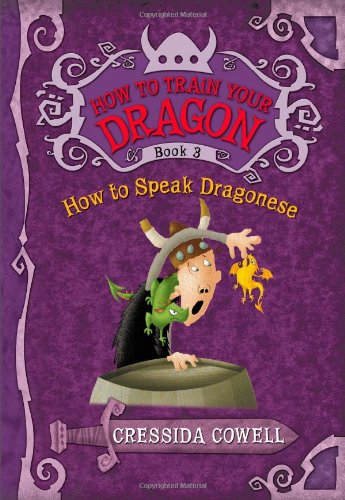
Book 3: How to Speak Dragonese
3 ½ out of 5 covers

Book 4: How to Cheat a Dragon’s Curse
 3 ½ out of 5 covers

The continuing adventures of Hiccup Horrendous Haddock III, his best friend, Fishlegs, and his dragon Toothless finds them raiding the wrong ship during pirate training in Book 3 and ending up prisoners of the Vikings’ worst enemy: the Romans.  Why do the Vikings hate Romans?  Because Romans are civilized.  This point does allow for some great juxtaposition between the idea of the Romans as civilized and their actions in plotting to steal all the dragons from Berk.  Being a prisoner also allows for the introduction of Camicazi, daughter of the Chieftaness of the Big-Boobied Burglars (and obviously potential love interest for Hiccup).   

In Book 4, Fishlegs is poisoned by the Venomous Vorpet and can only be cured by the Vegatable-That-No-One-Dares-Name.  This forces Hiccup and Camicazi to travel to the island on Hysteria and confront Norbert the Nutjob to steal the vegetable (a potato) to rescue their friend.

The author begins to develop the ongoing storylines in these volumes by introducing recurring villains and expanding the Viking world.  And there is some actual history being presented (the Romans, the idea that Vikings discovered America) albeit in deeply coded manner beneath the zaniness. 

It is that zaniness that ends up hurting the story some.  While the type of humor is entirely appropriate for the target readers, there are moments where the situation passes believability into the absurd. 
I recently came across the idea that the audience will suspend disbelief as long as the story is emotionally honest.  But it is also a balancing act in that the emotional honesty must exist within the rules of the world that have been established.  Cressinda Crowell definitely develops emotional honesty in these stories, creating empathy that has the reader rooting for Hiccup to overcome every obstacle.  But some of the action reaches a point where the laws of physics no longer appear to hold sway and credulity is bent towards the breaking point.  A greater balance will enhance the series.